
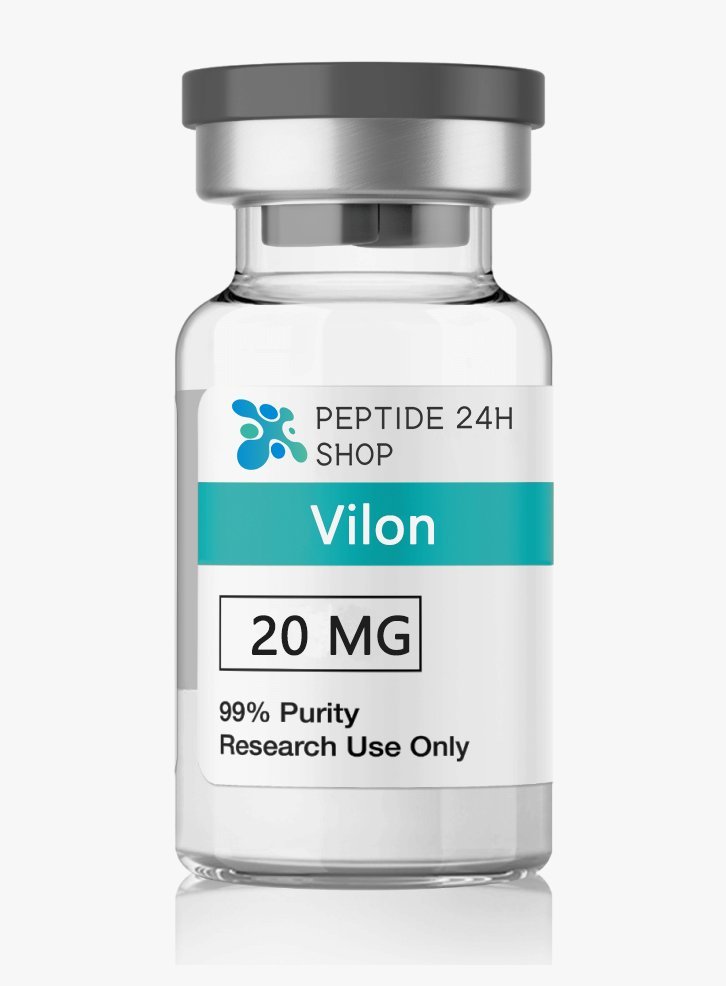
$55.00 – $258.00Price range: $55.00 through $258.00
CAS No.: 45234-02-4
Peptide Sequence: H-Lys-Glu-OH
Molecular Formula: C11H21N3O5
Molecular Weight: 275.3
Appearance: White Lyophilized powder
Vilon peptide is a biologically active, thymus-derived peptide widely used in laboratory research to study immune system function, thymus activity, cellular regeneration, and aging-related immune decline.
Renowned for its high purity, stability, and reproducible activity, Vilon serves as a reliable tool for scientists investigating immune modulation, T-cell regulation, and thymus-mediated mechanisms.
Vilon is a short-chain peptide that plays a key role in immune system regulation by influencing T-lymphocytes, which are critical for adaptive immunity.
In laboratory studies, Vilon peptide is commonly utilized for:
Its small molecular size allows precise handling, making it ideal for accurate modeling of immune responses in controlled experimental settings.
| Property | Description |
|---|---|
| Peptide Name | Vilon |
| Amino Acid Length | Short-chain peptide (varies by synthesis) |
| Purity | ≥98% (HPLC verified) |
| Form | Lyophilized powder |
| Molecular Weight | Approx. 400–1200 g/mol (depending on peptide variant) |
| Storage Temperature | –20°C (long-term stability) |
The high purity and stability of Vilon peptide ensures consistent, reproducible results in immune system and cellular research.
Vilon peptide is intended strictly for laboratory research. Key applications include:
Using Vilon in controlled experimental setups enables researchers to gain insights into immune function, thymus activity, and age-related cellular mechanisms.
To maintain Vilon peptide bioactivity:
Q1: What is the primary research use of Vilon peptide?
A: Vilon is mainly used to study immune system regulation, thymus function, cellular regeneration, and age-related immune decline.
Q2: What is the purity of Vilon peptide?
A: High-quality Vilon peptide is ≥98% pure, verified by HPLC testing.
Q3: Can Vilon be used in humans?
A: No. Vilon peptide is strictly for research purposes and is not approved for human use.
Q4: How should Vilon peptide be stored?
A: Keep lyophilized at –20°C; after reconstitution, refrigerate at 2–8°C. Avoid repeated freeze-thaw cycles.
Q5: Why is Vilon valuable for research?
A: Vilon regulates immune cells, influences cellular signaling pathways, and supports studies in immunology, thymus function, and regenerative medicine.
Vilon peptide is a high-purity, research-grade immunomodulatory peptide that supports studies of the immune system, thymus function, cellular regeneration, and age-related immune decline. Its small molecular size, stability, and reproducible activity make it an essential tool for laboratories conducting immunology, cellular biology, and regenerative medicine research.




&url=https://primehealthpharmacy.com/product/ghk-tripeptide-1/&media=https://primehealthpharmacy.com/wp-content/uploads/2026/01/GHK-Tripeptide-1.jpg)


&url=https://primehealthpharmacy.com/product/elamipretide-ss-31/&media=https://primehealthpharmacy.com/wp-content/uploads/2026/01/Elamipretide-SS-31.jpg)


