
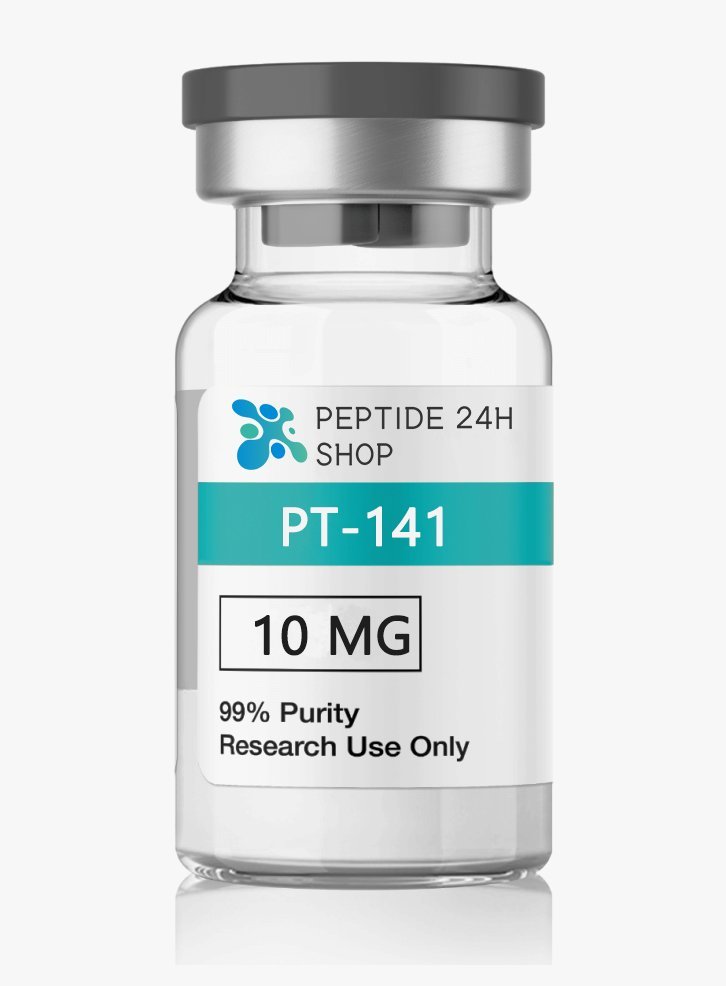
$55.00 – $450.00Price range: $55.00 through $450.00
Name: PT-141(Bremelanotide)
CAS No.: 189691-06-3 / 1607799-13-2
Peptide Sequence: Ac-Nle-Asp-His-D-Phe-Arg-Trp-Lys-OH (Chemical Bridge Asp2-Lys7)
Molecular Formula: C50H68N14O10
Molecular Weight: 1025.18
Appearance: White Lyophilized powder
PT-141, also known as Bremelanotide, is a synthetic peptide widely used in laboratory research to study receptor pathways and cellular interactions. It is particularly valued for its ability to interact with melanocortin receptors, making it a key tool for in-vitro investigations of molecular signaling.
This guide provides a comprehensive review and ranking of PT-141 peptides based on purity, synthesis quality, stability, and documentation, helping researchers select high-quality peptides for reliable laboratory experiments.
⚠️ Disclaimer: PT-141 peptides described here are for research use only and are not approved for human or veterinary consumption.
PT-141 is a short-chain synthetic peptide that functions as a melanocortin receptor agonist. In laboratory research, it is primarily used to:
Key Attributes for Research-Grade PT-141:
Selecting the right PT-141 peptide requires consideration of purity, synthesis method, stability, and supplier documentation. Below is a ranking based on research-grade criteria:
| Rank | Product | Purity | Form | Key Features | Research Applications |
|---|---|---|---|---|---|
| 1 | PT-141 Peptide A | >98% | Lyophilized powder | HPLC/MS verified, CoA included | In-vitro receptor signaling |
| 2 | PT-141 Peptide B | 97% | Lyophilized powder | High solubility, stable | Cellular assays, receptor studies |
| 3 | PT-141 Peptide C | >95% | Lyophilized powder | Optimized for receptor interaction | Molecular modeling, comparative studies |
| 4 | PT-141 Peptide D | 96% | Lyophilized powder | High reproducibility, verified | Cell signaling research |
| 5 | PT-141 Peptide E | 94% | Lyophilized powder | Cost-effective, consistent | Pilot studies, exploratory research |
Note: Rankings are based on laboratory research standards, including purity, verification, and reproducibility.
1. Purity and Verification
2. Synthesis Method
3. Stability and Storage
4. Documentation
PT-141 is primarily utilized in preclinical, in-vitro studies, including:
Its receptor-targeted properties make PT-141 highly valuable for molecular research, pharmacology, and assay development.
Proper handling ensures peptide integrity:
1. What is PT-141’s mechanism of action?
PT-141 acts as a melanocortin receptor agonist, primarily used in receptor signaling and cellular response studies.
2. Can PT-141 be used in humans?
No. These peptides are strictly for laboratory research and not approved for human or veterinary use.
3. How is PT-141 supplied?
Typically as a lyophilized powder with CoA and HPLC/MS data to verify purity.
4. What purity is recommended for research-grade PT-141?
≥95% purity confirmed via HPLC and mass spectrometry.
5. What are common research applications?
Receptor signaling assays, peptide-receptor interaction studies, cellular response analyses, and molecular modeling.
PT-141 peptides are essential tools for in-vitro molecular research, offering high purity, receptor specificity, and stability. When selecting PT-141 for experiments, prioritize:
With careful selection and handling, PT-141 peptides provide reproducible results, making them a cornerstone in peptide-based molecular research.
⚠️ For research use only. Not intended for human or veterinary consumption.





&url=https://primehealthpharmacy.com/product/ghk-tripeptide-1/&media=https://primehealthpharmacy.com/wp-content/uploads/2026/01/GHK-Tripeptide-1.jpg)


&url=https://primehealthpharmacy.com/product/elamipretide-ss-31/&media=https://primehealthpharmacy.com/wp-content/uploads/2026/01/Elamipretide-SS-31.jpg)


