
$55.00 – $1,300.00Price range: $55.00 through $1,300.00
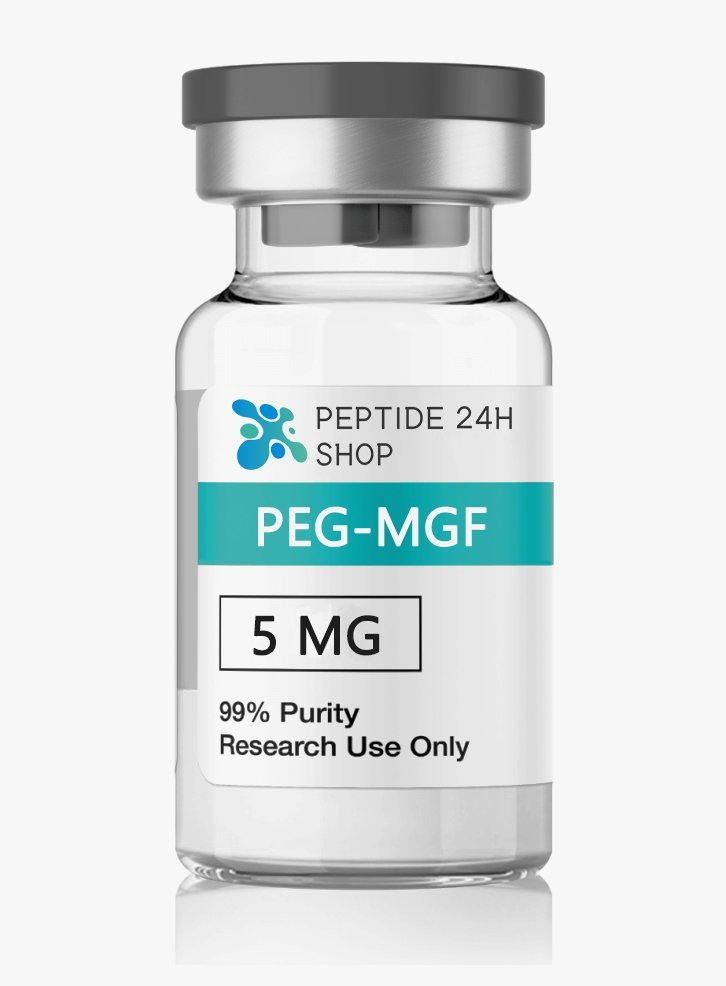
Name: PEG-MGF
Peptide Sequence: PEG1900-Suc-Tyr-Gln-Pro-Pro-Ser-Thr-Asn-Lys-Asn-Thr-Lys-Ser-Gln-D-Arg-D-Arg-Lys-Gly-Ser-Thr-Phe-Glu-Glu-Arg-Lys-NH2
PEG-MGF (Pegylated Mechano Growth Factor) is a synthetic peptide derived from Mechano Growth Factor (MGF), a tissue-specific splice variant of Insulin-like Growth Factor 1 (IGF-1).
By attaching polyethylene glycol (PEG) to the peptide chain, PEG-MGF gains enhanced stability, extended half-life, and reduced enzymatic degradation, making it highly useful for in vitro and in vivo research.
PEG-MGF is primarily employed to study cellular repair mechanisms, growth factor signaling, and tissue regeneration pathways.
PEGylation protects the peptide from enzymatic breakdown, enhancing biological availability and experimental reproducibility in research models.
Mechano Growth Factor (MGF) is expressed in response to mechanical stress or tissue injury and regulates cell proliferation and repair.
The development of PEG-MGF allows researchers to investigate how molecular stabilization affects:
This makes PEG-MGF an important tool in cellular biology, tissue engineering, and biochemical signaling research.
PEG-MGF is widely utilized across multiple research domains:
Its prolonged stability and adaptable structure make it an excellent model for studying synthetic peptide enhancement and signal transduction.
PEG-MGF peptide represents a major advancement in growth factor research. Its pegylated design enhances stability and biological activity, making it a highly reliable tool for studying cellular signaling, tissue regeneration, and peptide pharmacology.
While not approved for clinical use, PEG-MGF remains a core research peptide for laboratories exploring growth regulation, peptide modification technologies, and molecular engineering.






&url=https://primehealthpharmacy.com/product/ghk-tripeptide-1/&media=https://primehealthpharmacy.com/wp-content/uploads/2026/01/GHK-Tripeptide-1.jpg)


&url=https://primehealthpharmacy.com/product/elamipretide-ss-31/&media=https://primehealthpharmacy.com/wp-content/uploads/2026/01/Elamipretide-SS-31.jpg)


