
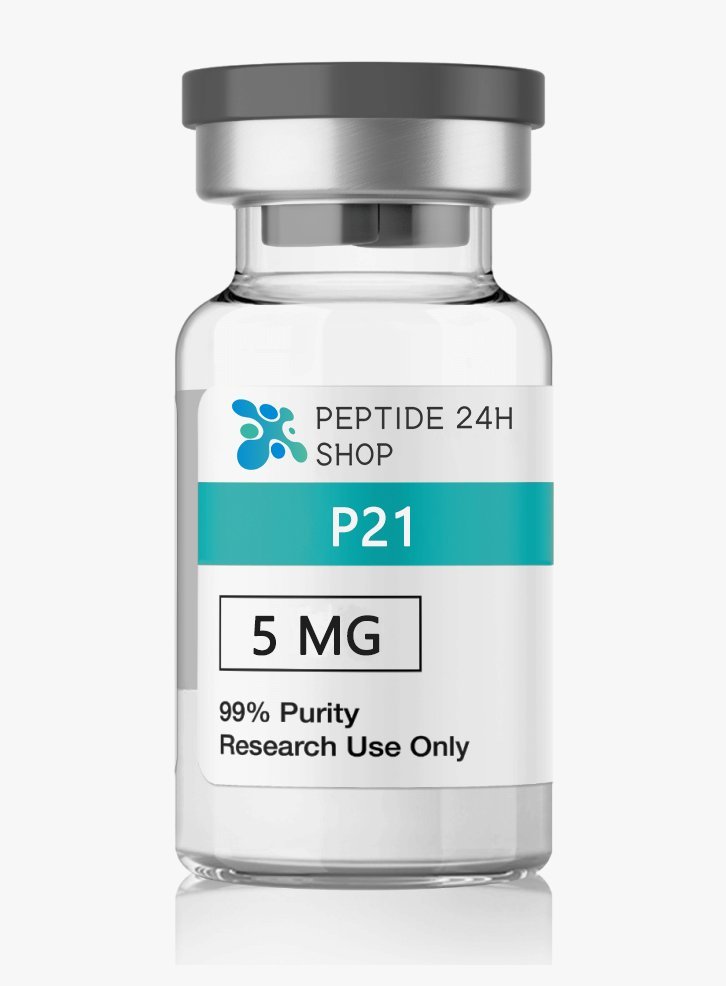
$95.00 – $950.00Price range: $95.00 through $950.00
Name: P21 (P021)
CAS No.: N/A
Peptide Sequence: Ac-Asp-Gly-Gly-Leu-Adamantane-NH2
Molecular Formula: C27H42N6O8
Molecular Weight: 578.7
Appearance: White Lyophilized powder
P21 peptide is a synthetic heptapeptide analog derived from the Semax family of neuroactive peptides. Recognized for its potential neurotrophic and synaptic regulatory effects, P21 has become a valuable tool in biochemical and neuroscience research.
Engineered through rational peptide design, it incorporates elements of Semax and C-terminal fragments of N-acetyl Semax analogs, offering enhanced stability and receptor-targeting potential in experimental settings.
Note: P21 peptide is a research-use-only (RUO) compound and is not approved for human or veterinary use.
Structural modifications improve enzymatic resistance and extend activity duration, making P21 ideal for peptide stability and receptor-binding studies.
P21 was designed as an advanced derivative of Semax to enhance bioavailability and neurotrophic potential. It is widely used in preclinical research to explore the effects of peptide structure on cognitive function, neuroplasticity, gene expression, and oxidative stress regulation.
The peptide’s unique sequence allows for the investigation of how specific modifications affect neurochemical signaling and molecular communication in neuronal tissues.
P21 peptide serves as a model compound in several experimental areas:
P21 peptide is applied in:
Its stable structure and robust peptide backbone make it ideal for studying short-chain peptide signaling and cellular feedback mechanisms in controlled laboratory settings.
Handling: Minimize freeze–thaw cycles and reconstitute immediately prior to use.
Usage: For laboratory research only (RUO); not for human or veterinary applications.
P21 peptide is a next-generation synthetic neuropeptide analog inspired by the Semax family, offering enhanced stability and versatile experimental utility. Its unique composition supports studies in neuroscience, peptide biochemistry, and molecular pharmacology, serving as a robust model for investigating peptide-mediated neurotrophic regulation.
While not intended for clinical use, P21 peptide remains a key tool for advancing the understanding of short-chain peptides in experimental research.





&url=https://primehealthpharmacy.com/product/ghk-tripeptide-1/&media=https://primehealthpharmacy.com/wp-content/uploads/2026/01/GHK-Tripeptide-1.jpg)


&url=https://primehealthpharmacy.com/product/elamipretide-ss-31/&media=https://primehealthpharmacy.com/wp-content/uploads/2026/01/Elamipretide-SS-31.jpg)


