
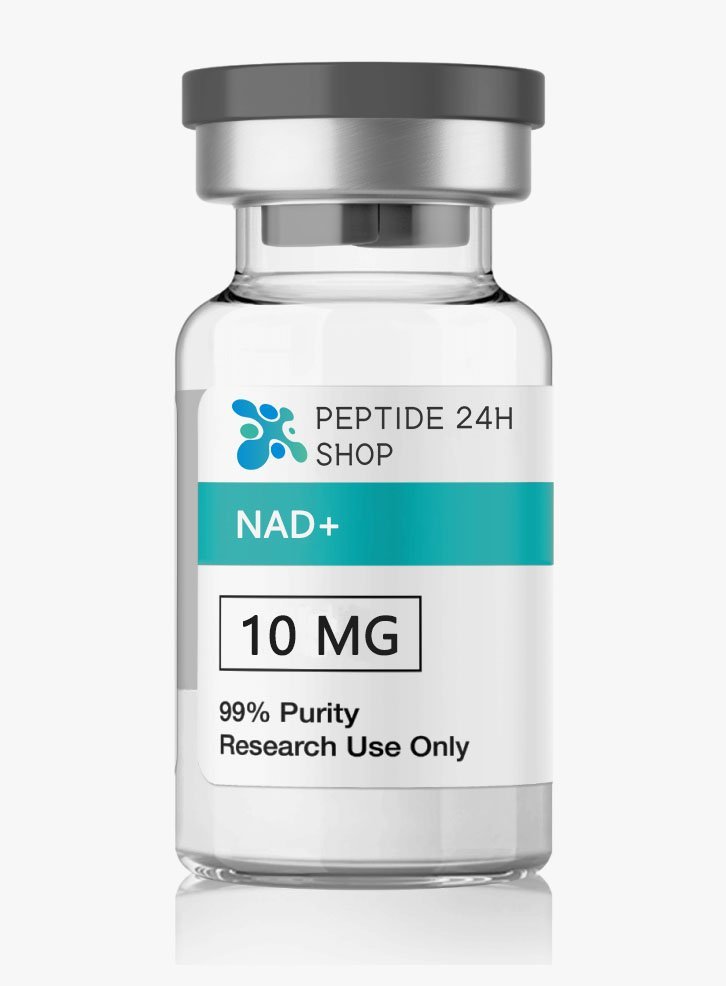
$55.00 – $159.00Price range: $55.00 through $159.00
Name: ??-Nicotinamide Adenine Dinucleotide (NAD+)
CAS No.: 53-84-9
Molecular Formula: C21H27N7O14P2
Molecular Weight: 663.4
Appearance:White to yellowish powder or erystalline powder
The NAD⁺ peptide is a novel research compound that combines the essential metabolic coenzyme nicotinamide adenine dinucleotide (NAD⁺) with peptide-based carrier technology. NAD⁺ is fundamental to cellular energy production, DNA maintenance, and intracellular signaling. By linking NAD⁺ to peptide structures, researchers aim to study how peptide conjugation may influence stability, cellular delivery, and intracellular distribution in experimental systems.
These peptide–NAD⁺ conjugates function as advanced laboratory tools for examining how carrier molecules affect coenzyme behavior and utilization at the cellular level.
Nicotinamide adenine dinucleotide (NAD⁺) is an endogenous coenzyme present in all living cells. It plays a pivotal role in oxidation–reduction reactions by shuttling electrons during metabolic processes that generate ATP, the cell’s primary energy source.
In its oxidized state, NAD⁺ participates in essential pathways such as glycolysis, the tricarboxylic acid (TCA) cycle, and oxidative phosphorylation. Variations in NAD⁺ availability over time have driven research interest in compounds that can help model its transport, recycling, and functional stability—leading to the development of NAD⁺ peptide conjugates for laboratory investigation.
Although specific formulations may differ, NAD⁺ peptides generally share the following features:
The peptide linkage enables researchers to examine how carrier molecules may affect NAD⁺ transport, stability, and biochemical activity in controlled research environments.
NAD⁺ peptide design originates from bioconjugate chemistry, a field focused on linking biologically active molecules to improve targeting, durability, or experimental performance. In laboratory settings, NAD⁺ peptide analogs are explored across cellular biology and biochemical engineering disciplines to study:
Current experimental work with NAD⁺ peptides typically concentrates on the following areas:
NAD⁺ functions as a cofactor in numerous redox reactions. Peptide-conjugated NAD⁺ allows researchers to investigate ATP production, oxidative balance, and energy transfer efficiency in cell-based models.
Many enzymes—including sirtuins, PARPs, and various dehydrogenases—depend on NAD⁺ availability. NAD⁺ peptide constructs provide a controlled platform to study enzyme–cofactor binding and catalytic behavior.
Peptide-linked NAD⁺ is used to explore membrane transport mechanisms, intracellular trafficking, and compartmentalization of coenzymes within biological systems.
NAD⁺ peptides are used strictly for laboratory research and academic study, commonly in:
The hybrid design of NAD⁺ peptides makes them valuable tools for advancing molecular biology, bioengineering, and biochemical research methodologies.
NAD⁺ peptide compounds are not approved by regulatory agencies such as the FDA or EMA for therapeutic, dietary, or clinical applications. They must be clearly labeled for research use only and handled by qualified personnel in accordance with institutional laboratory safety and compliance standards.
NAD⁺ peptides represent a forward-looking approach in biochemical research, combining a vital metabolic coenzyme with peptide engineering to investigate energy regulation, enzymatic function, and molecular transport.
Although restricted to experimental use, NAD⁺ peptide conjugates continue to support foundational research in cellular metabolism and molecular biochemistry, offering valuable insights into the complex dynamics of intracellular energy systems.




&url=https://primehealthpharmacy.com/product/ghk-tripeptide-1/&media=https://primehealthpharmacy.com/wp-content/uploads/2026/01/GHK-Tripeptide-1.jpg)


&url=https://primehealthpharmacy.com/product/elamipretide-ss-31/&media=https://primehealthpharmacy.com/wp-content/uploads/2026/01/Elamipretide-SS-31.jpg)


