
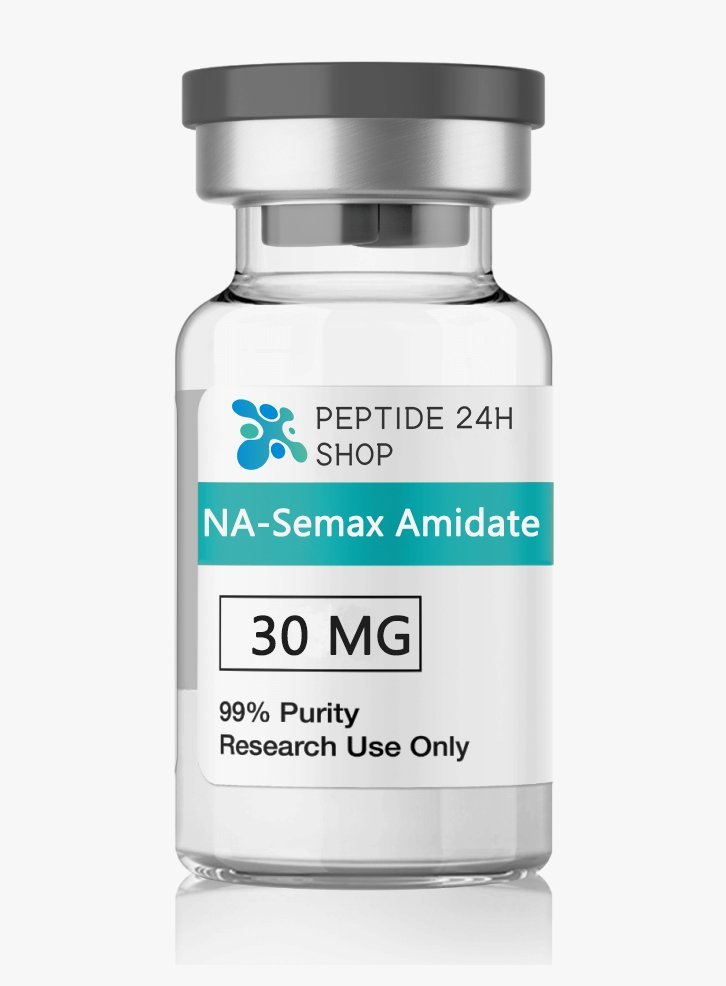
$75.00 – $299.00Price range: $75.00 through $299.00
Name:?N-Acetyl Semax Amidate; Ac-Semax Amidate; Ac-Semax-NH2
CAS No.: N/A
Peptide Sequence: Ac-Met-Glu-His-Phe-Pro-Gly-Pro-NH2
Appearance: White Lyophilized powder
N-Acetyl Semax Amidate (NA-Semax-Amidate) is an advanced synthetic peptide belonging to the Semax family of neuroactive heptapeptides. Designed with both N-terminal acetylation and C-terminal amidation, this modified structure offers improved molecular stability and enhanced resistance to enzymatic degradation, making it well suited for experimental and biochemical research.
Its refined chemical profile allows researchers to examine neuroregulatory pathways and peptide behavior under controlled laboratory conditions.
The combined acetylation and amidation modifications significantly enhance peptide durability, supporting prolonged stability during in-vitro and in-vivo experimental work.
Semax-based peptides were originally developed through neuropeptide research programs aimed at modeling fragments of ACTH (4–10) and their effects on neural signaling. NA-Semax-Amidate was later engineered as a more structurally resilient analogue, allowing researchers to explore neurochemical activity with greater experimental consistency.
This enhanced version provides a dependable platform for studying peptide behavior, signaling pathways, and neuroregulatory mechanisms.
Although not approved for therapeutic or dietary use, NA-Semax-Amidate is actively explored in preclinical research environments. Key investigative areas include:
Related Semax analogs have demonstrated potential involvement in pathways associated with BDNF and NGF, which play essential roles in neuronal growth and maintenance.
Researchers study Semax-type peptides for their influence on oxidative balance, antioxidant enzyme activity, and adaptive cellular responses under stress conditions.
Experimental models suggest that Semax derivatives may affect neurotransmission and synaptic efficiency, positioning NA-Semax-Amidate as a useful tool for cognitive mechanism research.
N-Acetyl Semax Amidate is commonly used in laboratory studies to examine:
Its enhanced chemical stability makes it especially suitable for experimental models requiring sustained peptide exposure.
⚠️ Research Use Only:
NA-Semax-Amidate is intended strictly for laboratory research. It is not approved for human, veterinary, or medical use. All handling must comply with institutional safety standards and regulatory guidelines.
N-Acetyl Semax Amidate is classified as a research-use-only (RUO) compound. It has not received approval from regulatory authorities such as the FDA, EMA, or TGA. Distribution and use must remain confined to non-clinical research settings.
N-Acetyl Semax Amidate represents a refined evolution of Semax peptide research, offering enhanced molecular stability and experimental reliability. Its structural modifications provide researchers with a robust model for investigating neurochemical signaling, peptide engineering, and structure-function relationships in synthetic heptapeptides.
By examining compounds like NA-Semax-Amidate, scientists can better understand how targeted chemical modifications influence peptide behavior and biological activity at the molecular level.




&url=https://primehealthpharmacy.com/product/ghk-tripeptide-1/&media=https://primehealthpharmacy.com/wp-content/uploads/2026/01/GHK-Tripeptide-1.jpg)


&url=https://primehealthpharmacy.com/product/elamipretide-ss-31/&media=https://primehealthpharmacy.com/wp-content/uploads/2026/01/Elamipretide-SS-31.jpg)


