
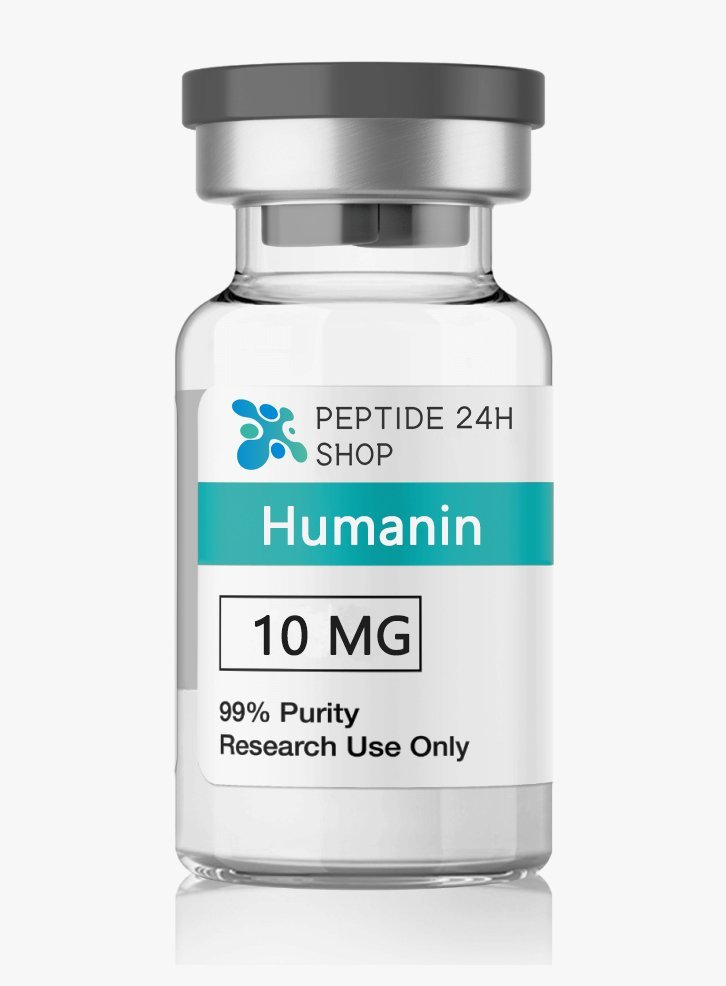
$80.00 – $800.00Price range: $80.00 through $800.00
Name: Humanin human; Humanin
CAS No.: 330936-69-1
Peptide Sequence: Met-Ala-Pro-Arg-Gly-Phe-Ser-Cys-Leu-Leu-Leu-Leu-Thr-Ser-Glu-Ile-Asp-Leu-Pro-Val-Lys-Arg-Arg-Ala
Molecular Formula: C119H204N34O32S2
Molecular Weight: 2687.27
Appearance: White Lyophilized powder
Humanin is a notable discovery in mitochondrial biology. It is a small peptide encoded by mitochondrial DNA rather than nuclear DNA, distinguishing it from most known peptides. In experimental research, Humanin has been examined for its potential involvement in cellular stress resistance, mitochondrial function, and mechanisms related to cellular aging.
Due to these properties, Humanin has attracted significant interest among researchers studying mitochondrial signaling, metabolic regulation, and longevity pathways. It is important to emphasize that Humanin is strictly intended for laboratory research and is not approved for therapeutic, medical, or human use.
Humanin is a mitochondrial-derived peptide (MDP) composed of 24 amino acids. It originates from the mitochondrial 16S rRNA gene, which is part of the mitochondrial genome responsible for cellular energy production.
Within research models, Humanin acts as a signaling molecule, facilitating communication between mitochondria and other cellular components. Through this signaling role, it has been associated with pathways involved in cell survival, oxidative stress regulation, and energy homeostasis.
Its mitochondrial origin makes Humanin a key focus in contemporary research on aging, metabolism, and cellular defense systems.
| Property | Specification |
|---|---|
| Amino acid length | 24 residues |
| Molecular weight | ~2,687 g/mol |
| Appearance | White to off-white lyophilized powder |
| Purity (research grade) | ≥ 98% (HPLC verified) |
| Storage conditions | −20 °C, dry and protected from light |
| Solubility | Water, acetic acid, or DMSO |
| Form | Synthetic, lyophilized peptide |
When properly stored, lyophilized Humanin remains stable for up to two years. Once reconstituted, it should be used promptly under controlled laboratory conditions.
Experimental research suggests that Humanin may function as a protective cellular peptide, interacting with both mitochondrial and cytoplasmic signaling pathways.
Proposed mechanisms include:
Together, these functions make Humanin an important molecule for studying mitochondrial resilience, stress adaptation, and aging-related processes.
While Humanin is not approved for medical or therapeutic use, laboratory studies have explored its behavior in various experimental models.
a) Cellular Protection
Humanin has been investigated for its potential role in protecting cells from oxidative and metabolic stress, supporting mitochondrial function, and limiting cellular damage.
b) Neuroprotection
Its observed effects on neuronal survival under oxidative or excitotoxic stress have made it a frequent subject of neurological research.
c) Aging and Longevity
Some animal studies have reported age-related declines in Humanin expression, prompting investigation into its relationship with cellular aging and lifespan regulation.
d) Metabolic Regulation
In experimental systems, Humanin has been associated with changes in insulin sensitivity, lipid metabolism, and energy utilization.
e) Cardiovascular and Energy Metabolism Research
Due to its mitochondrial origin, Humanin is also studied in relation to cardiac mitochondrial efficiency and energy production under stress conditions.
⚠️ Note: All findings referenced above are derived from laboratory research. Humanin is not an approved drug, supplement, or treatment.
Humanin peptide should be handled exclusively in professional research settings by qualified personnel, following standard laboratory safety procedures.
Humanin is intended solely for scientific research and must not be used for human or veterinary purposes.
When sourcing Humanin for research, laboratories typically verify the following:
Consistent quality is essential for experimental reproducibility and reliable research outcomes.
Q1. What distinguishes Humanin from other peptides?
Humanin is encoded by mitochondrial DNA rather than nuclear DNA, making it a unique signaling peptide involved in mitochondrial-to-cellular communication.
Q2. What is Humanin primarily studied for?
It is researched for its potential roles in cellular protection, mitochondrial stability, metabolic regulation, and aging biology.
Q3. Can Humanin be used as a supplement?
No. Humanin is a research compound only and is not approved for human consumption or supplementation.
Q4. What is the recommended storage temperature?
Lyophilized Humanin should be stored at −20 °C, protected from light and moisture.
Q5. What are mitochondrial-derived peptides (MDPs)?
MDPs are small peptides, such as Humanin and MOTS-c, encoded by mitochondrial DNA that function as signaling molecules involved in cellular survival and energy regulation.
Humanin represents a significant advancement in mitochondrial research. As a naturally encoded mitochondrial peptide, it offers valuable insight into cellular defense mechanisms, metabolic regulation, and aging biology.
Its unique origin and signaling properties make Humanin a valuable research tool for scientists investigating mitochondrial communication, cellular resilience, and lifespan-related processes.
Disclaimer: This material is provided for scientific and educational purposes only. Humanin peptide is not approved for medical use and is intended exclusively for laboratory research.




&url=https://primehealthpharmacy.com/product/ghk-tripeptide-1/&media=https://primehealthpharmacy.com/wp-content/uploads/2026/01/GHK-Tripeptide-1.jpg)


&url=https://primehealthpharmacy.com/product/elamipretide-ss-31/&media=https://primehealthpharmacy.com/wp-content/uploads/2026/01/Elamipretide-SS-31.jpg)


