
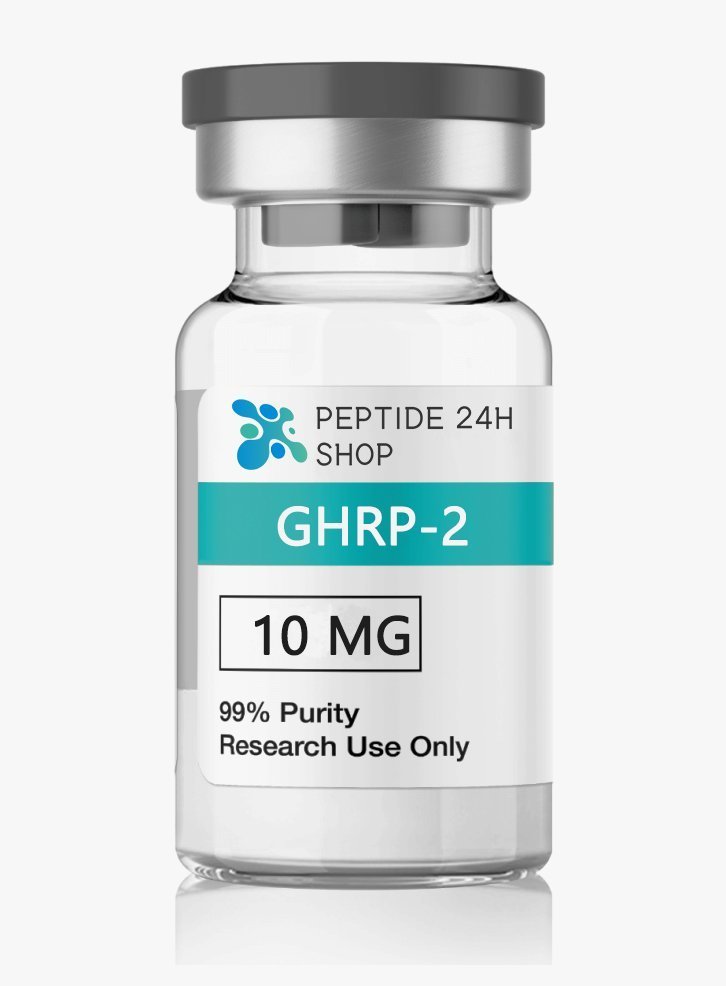
$45.00 – $270.00Price range: $45.00 through $270.00
Name: GHRP-2; Pralmorelin
CAS No.: 158861-67-7
Peptide Sequence: H-D-Ala-D-2-Nal-Ala-Trp-D-Phe-Lys-NH2
Molecular Formula: C45H55N9O6
Molecular Weight: 817.97
Appearance: White Lyophilized powder
GHRP-2, or Growth Hormone Releasing Peptide-2, is a synthetic hexapeptide widely used in endocrinology, peptide biochemistry, and molecular signaling research. Designed to mimic natural growth hormone secretagogues, GHRP-2 is primarily employed in laboratory studies to investigate:
GHRP-2 has become a key tool for exploring GHS-R1a receptor interactions and the physiological mechanisms underlying GH release.
GHRP-2 belongs to the Growth Hormone Releasing Peptide (GHRP) family, which includes GHRP-6, Ipamorelin, and Hexarelin. These peptides act as GH secretagogues, binding to the ghrelin receptor (GHS-R1a) to stimulate growth hormone release in preclinical models.
Chemical sequence:
D-Ala-D-2-Nal-Ala-Trp-D-Phe-Lys-NH₂
This hexapeptide’s structure ensures high receptor affinity and specificity, making it a valuable research molecule for studying peptide-receptor signaling and endocrine regulation.
| Property | Description |
|---|---|
| Peptide sequence | D-Ala-D-2-Nal-Ala-Trp-D-Phe-Lys-NH₂ |
| Molecular formula | C45H55N9O6 |
| Molecular weight | ~817 Da |
| Solubility | Soluble in sterile water or dilute acids |
| Appearance | White to off-white lyophilized powder |
| Storage | Stable at –20°C, protected from light and moisture |
GHRP-2’s stability and receptor specificity make it ideal for controlled in vitro and in vivo research.
GHRP-2 functions as a growth hormone secretagogue through two primary mechanisms:
GHRP-2 binds to the growth hormone secretagogue receptor in the pituitary and hypothalamus, triggering GH secretion via calcium-dependent signaling pathways.
Experimental models demonstrate that GHRP-2 can influence neuroendocrine feedback loops involving GH, GHRH, and somatostatin, regulating hormone release.
Additional preclinical research has investigated GHRP-2’s effects on:
These pathways are explored exclusively in laboratory and preclinical studies.
GHRP-2’s precise GH-releasing activity makes it widely used in:
Its specificity and reproducible receptor activity make GHRP-2 a benchmark peptide for endocrine signaling studies.
To ensure reproducibility and peptide integrity:
Proper handling maintains stability for months or longer, depending on storage conditions.
GHRP-2 is strictly for research use only:
Q: What is GHRP-2 used for in research?
A: GHRP-2 is primarily used to study GH secretion, receptor interactions, and peptide-mediated endocrine signaling.
Q: How does GHRP-2 compare to GHRP-6?
A: Both are GH secretagogues, but GHRP-2 typically shows stronger receptor binding and more consistent GH stimulation.
Q: Can GHRP-2 be used therapeutically?
A: No. GHRP-2 is intended only for preclinical and laboratory research.
Q: How should GHRP-2 be stored?
A: Lyophilized peptide should be stored at –20°C, protected from light and moisture, and reconstituted immediately before use.
GHRP-2 peptide (Growth Hormone Releasing Peptide-2) remains a cornerstone research tool in peptide science, endocrine studies, and GH secretagogue research. Its predictable activity on the GHS-R1a receptor and influence on GH pathways make it invaluable for understanding pituitary function, peptide signaling, and hormone regulation.
For molecular biologists, endocrinologists, and peptide researchers, GHRP-2 provides a robust experimental model for studying hormone modulation and receptor pharmacology, advancing insights into cellular communication and endocrine regulation.





&url=https://primehealthpharmacy.com/product/ghk-tripeptide-1/&media=https://primehealthpharmacy.com/wp-content/uploads/2026/01/GHK-Tripeptide-1.jpg)


&url=https://primehealthpharmacy.com/product/elamipretide-ss-31/&media=https://primehealthpharmacy.com/wp-content/uploads/2026/01/Elamipretide-SS-31.jpg)


