
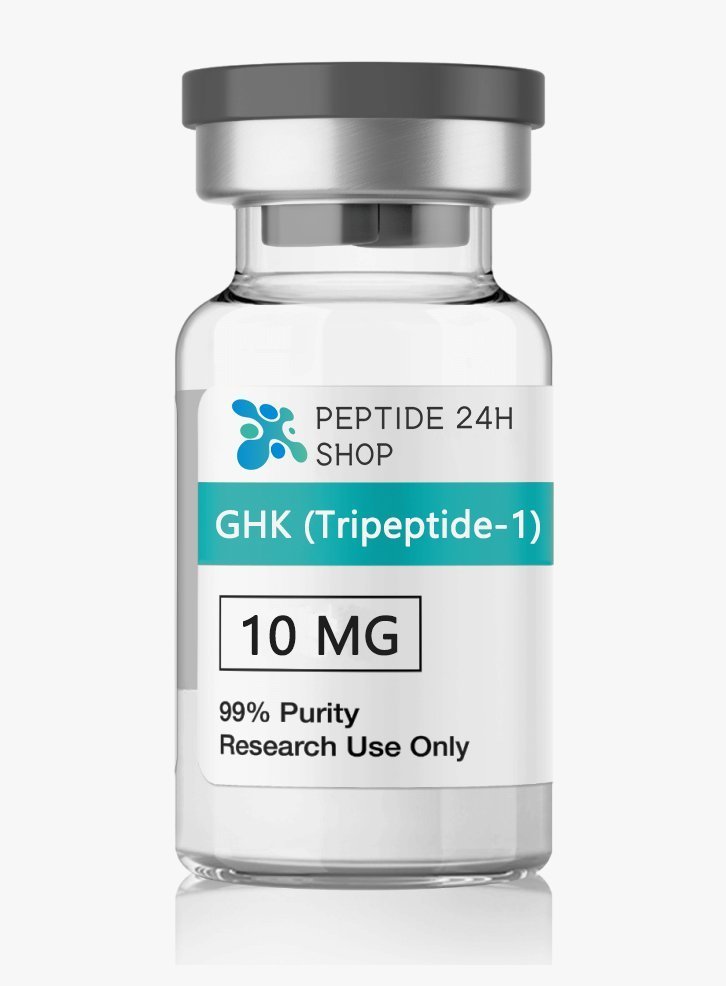
$69.00 – $79.00Price range: $69.00 through $79.00
Name: Tripeptide-1; GHK; Prezatide monoacetate
CAS No.: 49557-75-7 / 72957-37-0
Peptide Sequence: H-Gly-His-Lys-OH
Molecular Formula: C16H28N6O6
Molecular Weight: 400.44
Appearance: White Lyophilized powder
GHK peptide, also known as Tripeptide-1 or GHK-Cu ( Copper Peptide) when bound to copper, is a naturally occurring tripeptide composed of glycine, histidine, and lysine. It has attracted significant attention in molecular biology, regenerative research, and peptide science due to its role in cellular signaling, gene expression modulation, and tissue remodeling pathways.
This scientific overview explores the chemical structure, biochemical properties, mechanisms studied in preclinical research, and laboratory applications of GHK, making it a valuable reference for researchers and peptide specialists.
GHK is a short-chain peptide with the amino acid sequence:
Glycine – Histidine – Lysine (Gly-His-Lys)
It is naturally present in human plasma, saliva, and urine, where it participates in biological signaling processes related to:
In laboratory environments, GHK is frequently studied in its copper-bound form (GHK-Cu), which enhances its stability and biological activity in experimental models.
The simplicity of GHK’s structure contributes to its versatility in research settings.
Key Characteristics:
When complexed with copper, GHK facilitates copper transport and cellular bioavailability, which is essential for multiple enzymatic and oxidative stress-related processes studied in vitro.
Due to its small molecular size, GHK demonstrates efficient cellular interaction in laboratory models, making it suitable for cell culture assays and preclinical studies.
Current research on GHK peptide focuses on its role as a cell-signaling molecule and gene expression modulator.
Preclinical studies suggest that GHK influences the expression of genes involved in:
This regulatory function makes it of interest in regenerative biology research.
The GHK-Cu complex plays a role in copper homeostasis by:
Copper is essential for various enzymatic reactions, including those studied in collagen and structural protein research.
Laboratory studies associate GHK with pathways involved in:
Research models indicate GHK may influence oxidative stress markers and inflammatory signaling pathways, contributing to cellular homeostasis in controlled laboratory environments.
Important: GHK (Tripeptide-1) is designated for research use only and is not approved for therapeutic or clinical applications.
GHK is widely used in scientific investigations across multiple disciplines:
These applications position GHK peptide as a versatile research compound in cellular biology and regenerative science.
To maintain stability and reproducibility in laboratory experiments, proper peptide handling is essential.
Best Practices:
Adhering to proper storage and preparation procedures ensures consistent experimental outcomes.
GHK (Tripeptide-1 / GHK-Cu) is strictly classified as a research-use-only peptide.
Researchers are responsible for adhering to local and institutional regulations governing experimental compounds.
GHK-Cu is the copper-bound form of GHK peptide. Binding to copper enhances stability and biological activity in laboratory research models.
No. GHK is designated for research purposes only and is not approved for clinical or medical treatment.
GHK is studied for its role in gene expression regulation, copper transport, extracellular matrix signaling, and cellular repair pathways.
Store lyophilized GHK at –20°C or below. Reconstitute prior to use and avoid multiple freeze-thaw cycles.
GHK peptide (Tripeptide-1) is a well-studied copper-binding research peptide with broad applications in molecular biology, regenerative research, and cellular signaling studies. Its ability to modulate gene expression, influence copper bioavailability, and participate in structural protein pathways makes it a valuable tool in laboratory environments.
For researchers and peptide specialists, GHK-Cu provides a robust platform for investigating cellular maintenance, tissue remodeling, and molecular regulatory mechanisms under controlled experimental conditions.






&url=https://primehealthpharmacy.com/product/elamipretide-ss-31/&media=https://primehealthpharmacy.com/wp-content/uploads/2026/01/Elamipretide-SS-31.jpg)


