
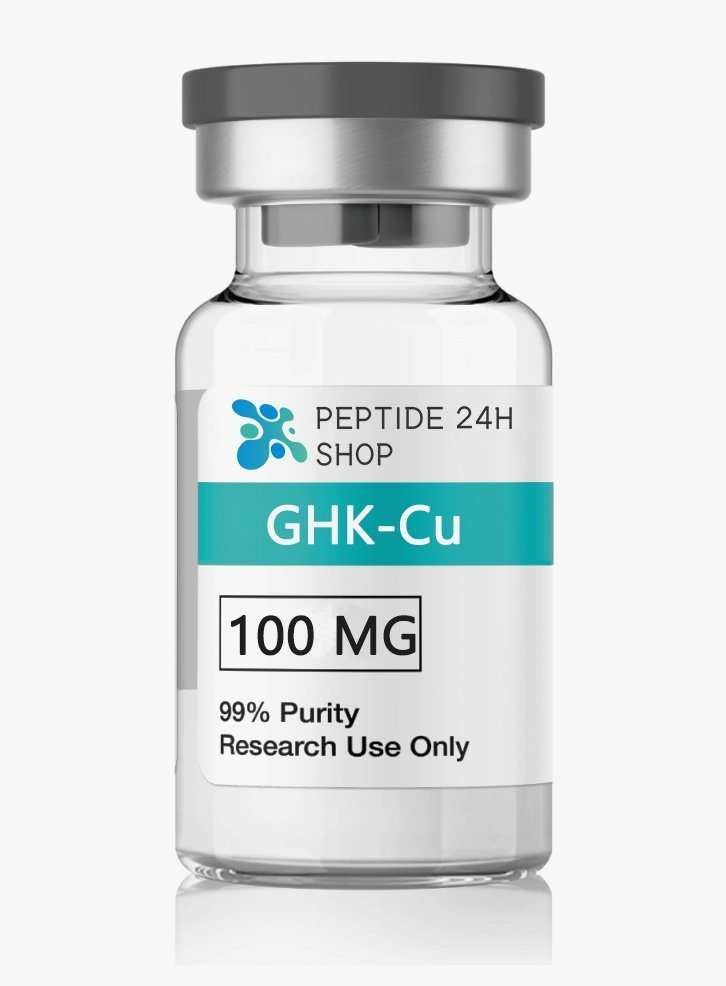
$140.00
Name: GHK-Cu;?Copper peptide;?COPPER TRIPEPTIDE-1
CAS No.: 130120-57-9 / 89030-95-5
Peptide Sequence: Gly-His-Lys-Cu
Molecular Formula: 2C14H24N6O4 Cu.2C2H4O2
Molecular Weight:GHK:340.5
Appearance: Blue Lyophilized powder
GHK-Cu peptide, also known as Copper Tripeptide-1, is a naturally occurring copper-binding complex formed by the tripeptide GHK (Glycine-Histidine-Lysine) and a copper (II) ion. Since its identification in human plasma in the 1970s, GHK-Cu has become a significant focus in molecular biology, regenerative research, and biochemical studies.
Researchers study GHK-Cu for its role in:
This comprehensive overview explores the chemical structure, molecular properties, research mechanisms, and laboratory applications of GHK-Cu peptide, providing a clear scientific resource for researchers and peptide specialists.
GHK-Cu is the copper-complexed form of the naturally occurring tripeptide GHK (Gly-His-Lys). The peptide is found in plasma, saliva, and various tissues, where it functions as a biological carrier molecule for copper—an essential trace element involved in enzymatic reactions and cellular processes.
When bound to copper, GHK-Cu demonstrates:
Because copper is required for multiple enzymatic systems, GHK-Cu is widely used in research exploring copper-dependent cellular pathways, extracellular matrix regulation, and oxidative balance mechanisms.
GHK-Cu’s biochemical profile makes it particularly suitable for laboratory research.
Key Properties:
Its small molecular size supports efficient cellular interaction in vitro, while its strong copper-binding affinity allows modulation of copper bioavailability in biological systems.
Although research is ongoing, several mechanisms of action have been investigated in laboratory and preclinical models.
Cell culture studies suggest that GHK-Cu may influence the expression of numerous genes associated with:
This regulatory potential makes GHK-Cu a molecule of interest in regenerative biology research.
GHK-Cu acts as a copper delivery peptide, facilitating copper availability for enzymes involved in:
Copper-dependent enzymes, such as superoxide dismutase (SOD), are frequently examined in experimental models using GHK-Cu.
Research indicates that GHK-Cu may influence oxidative stress markers and cellular homeostasis pathways under controlled laboratory conditions.
Preclinical models have explored GHK-Cu’s role in:
It is important to note that these findings are limited to laboratory and preclinical research. GHK-Cu is not approved for therapeutic or clinical use.
GHK-Cu peptide is widely used across several scientific disciplines.
Its broad applicability makes GHK-Cu an important research peptide in cellular and biochemical sciences.
To maintain peptide integrity and ensure reproducible research outcomes:
Proper storage preserves molecular stability and experimental reliability.
GHK-Cu (Copper Tripeptide-1) is designated strictly for research use only.
Researchers are responsible for adhering to institutional and regional guidelines when working with peptide compounds.
Yes. GHK is a naturally occurring tripeptide that binds copper (II) ions within biological systems.
It is primarily used in studies related to gene regulation, copper metabolism, extracellular matrix synthesis, and cellular signaling pathways.
No. GHK-Cu is classified as a research peptide and is not approved for clinical or medical treatment.
Store lyophilized GHK-Cu at –20°C in a sealed container, protected from moisture and light.
GHK-Cu peptide (Copper Tripeptide-1) is a well-characterized copper-binding research compound with broad applications in molecular biology, regenerative research, and biochemical investigations. Its small tripeptide structure and strong affinity for copper make it a valuable model molecule for studying cell signaling, tissue remodeling, and copper-dependent enzymatic pathways.
Although limited to laboratory research use, GHK-Cu continues to play a central role in advancing the scientific understanding of cellular maintenance, gene expression modulation, and regenerative biology.




&url=https://primehealthpharmacy.com/product/ghk-tripeptide-1/&media=https://primehealthpharmacy.com/wp-content/uploads/2026/01/GHK-Tripeptide-1.jpg)


&url=https://primehealthpharmacy.com/product/elamipretide-ss-31/&media=https://primehealthpharmacy.com/wp-content/uploads/2026/01/Elamipretide-SS-31.jpg)


