
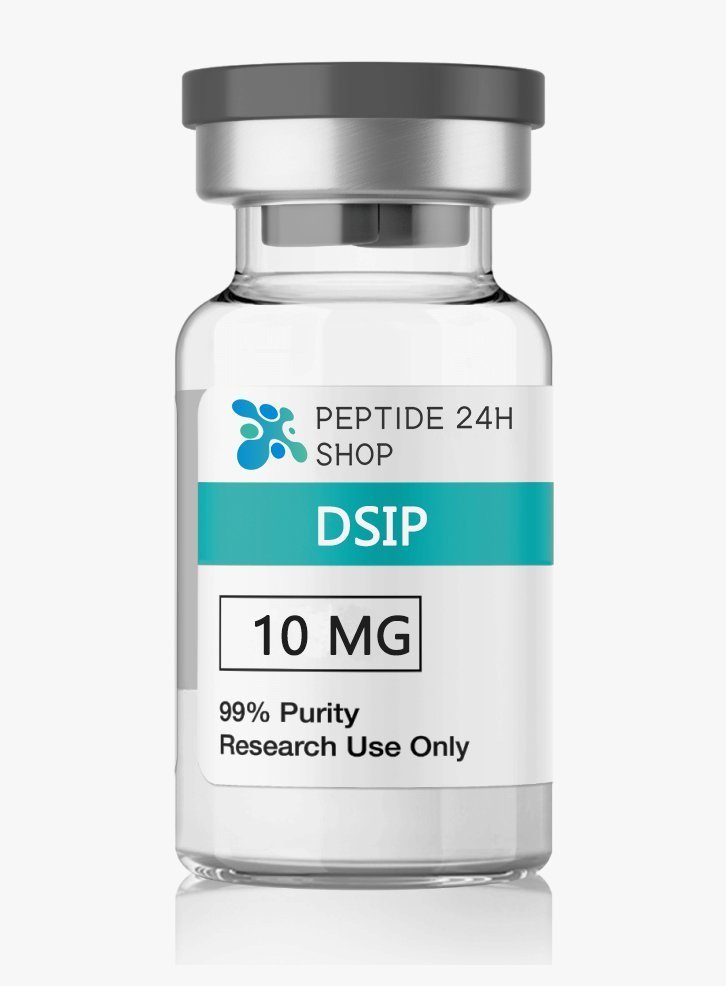
$45.00 – $125.00Price range: $45.00 through $125.00
Name: DSIP; Emideltide; Delta-Sleep Inducing Peptide
CAS No.: 62568-57-4
Peptide Sequence: Trp-Ala-Gly-Gly-Asp-Ala-Ser-Gly-Glu
Molecular Formula: C35H48N10O15
Molecular Weight: 848.814
Appearance: White Lyophilized powder
Delta Sleep-Inducing Peptide (DSIP) is a small neuropeptide recognized for its potential role in sleep regulation, neuroendocrine signaling, and stress modulation. First discovered in the 1970s, DSIP is a nonapeptide (nine amino acids) that has been extensively studied in laboratory research for its influence on deep sleep patterns, hormonal balance, and central nervous system activity.
This guide offers a detailed overview of DSIP’s structure, mechanisms, and experimental applications, making it a valuable resource for researchers, molecular biologists, and peptide enthusiasts. (This article is for informational purposes only and is not medical advice.)
DSIP is a naturally occurring peptide found in the brain and peripheral tissues. Its amino acid sequence is:
Trp-Ala-Gly-Gly-Asp-Ala-Ser-Gly-Glu
As a neuropeptide, DSIP functions as a signaling molecule in the nervous system. It was first isolated from the cerebral cortex of rabbits, where it was linked to delta wave sleep, the restorative phase crucial for physical recovery and memory consolidation.
Today, DSIP continues to be studied for its effects on sleep architecture, stress response, and hormonal modulation in preclinical research.
Key features of DSIP include:
Its simple yet stable structure allows DSIP to cross the blood-brain barrier in certain experimental models, making it a promising molecule for neuroscience research.
Although DSIP’s mechanisms are still under investigation, research suggests:
These effects have primarily been observed in animal models and preclinical studies. DSIP remains a research-use-only peptide.
Several peptides influence sleep, including Melatonin, Orexin, and GHRH (Growth Hormone-Releasing Hormone). DSIP is distinct due to its:
This makes DSIP a unique tool for sleep research and neuroscience studies.
DSIP is widely used in experimental settings to study:
Its molecular properties and specificity make DSIP a valuable research peptide in neuroscience, endocrinology, and sleep studies.
To maintain stability and experimental reliability, DSIP should be:
Proper handling ensures accurate and reproducible research results.
Preclinical studies suggest minimal toxicity in controlled research environments, but human safety data is limited.
Q: Is DSIP approved for medical use?
A: No. DSIP is strictly a research peptide and not approved for clinical applications.
Q: How does DSIP differ from melatonin or orexin?
A: DSIP specifically enhances delta wave sleep and modulates neuroendocrine pathways, whereas melatonin and orexin mainly regulate circadian rhythm or wakefulness.
Q: Can DSIP cross the blood-brain barrier?
A: Yes, experimental evidence indicates it can, facilitating central nervous system effects in some models.
Q: How is DSIP prepared for research?
A: Typically reconstituted in sterile solutions and used in animal models or cell cultures.
Delta Sleep-Inducing Peptide (DSIP) is a promising research peptide for studying sleep physiology, hormonal regulation, and central nervous system signaling. While its clinical use remains unapproved, DSIP continues to serve as a valuable tool for researchers exploring sleep architecture, stress response, and neuroendocrine interactions.
For scientists and peptide enthusiasts, DSIP provides a unique platform to advance knowledge in sleep biology and peptide-based research.
✅ SEO Optimization Highlights:









&url=https://primehealthpharmacy.com/product/ghk-tripeptide-1/&media=https://primehealthpharmacy.com/wp-content/uploads/2026/01/GHK-Tripeptide-1.jpg)


&url=https://primehealthpharmacy.com/product/elamipretide-ss-31/&media=https://primehealthpharmacy.com/wp-content/uploads/2026/01/Elamipretide-SS-31.jpg)


