
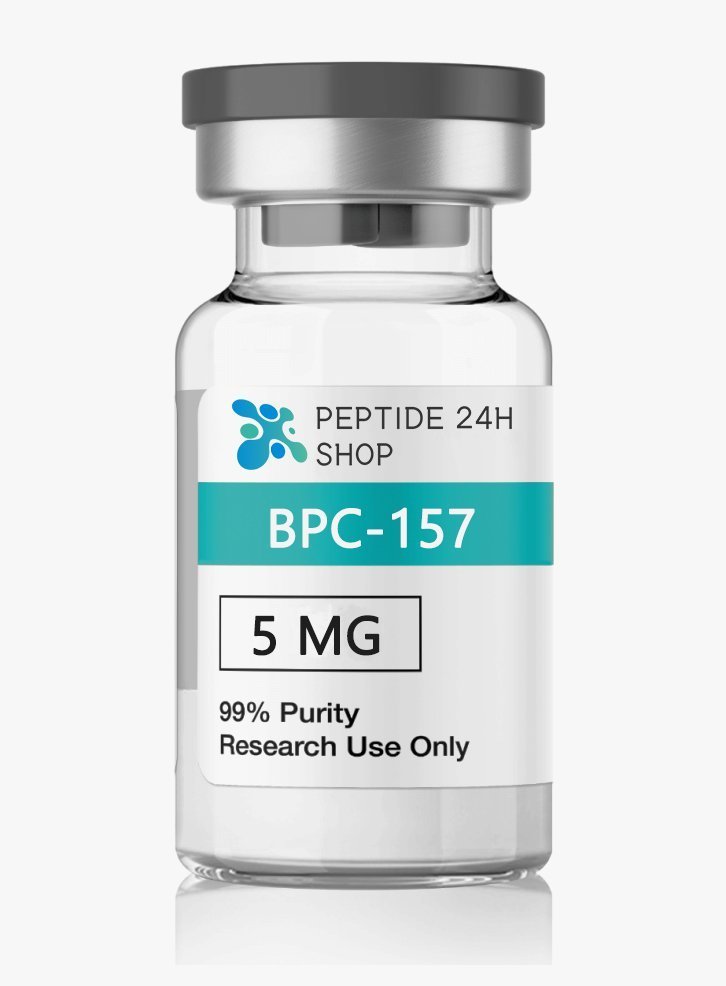
$65.00 – $165.00Price range: $65.00 through $165.00
Name: BPC-157; BPC157; BPC 157; pentadecapeptide BPC 157
CAS No.: 137525-51-0
Peptide Sequence: Gly-Glu-Pro-Pro-Pro-Gly-Lys-Pro-Ala-Asp-Asp-Ala-Gly-Leu-Val
Molecular Formula: C62H98N16O22
Molecular Weight: 1419.56
Appearance: White Lyophilized powder
In the rapidly expanding field of peptide research, BPC-157 peptide (Body Protection Compound-157) has become one of the most discussed investigational compounds. Originally derived from a naturally occurring gastric juice protein fragment, this synthetic pentadecapeptide has attracted scientific interest for its broad biological activity in preclinical models.
This page provides an evidence-based overview of:
All information is presented for educational and research awareness purposes only.
BPC-157 (Body Protection Compound-157) is a synthetic 15-amino-acid peptide (pentadecapeptide) derived from a fragment of a naturally occurring gastric protein. In published research, it is sometimes referred to as a gastric pentadecapeptide.
Amino acid sequence:
Gly-Glu-Pro-Pro-Pro-Gly-Lys-Pro-Ala-Asp-Asp-Ala-Gly-Leu-Val
Although widely discussed in online communities for tissue repair and healing, it is important to clarify:
As such, BPC-157 remains an investigational compound.
Interest in BPC-157 stems from its multi-pathway biological activity observed in laboratory models.
Research suggests BPC-157 may promote angiogenesis (formation of new blood vessels) through:
Angiogenesis plays a central role in tissue repair and vascular recovery in experimental injury models.
BPC-157 appears to interact with the nitric oxide system, influencing:
Nitric oxide regulation is closely linked to tissue perfusion and repair mechanisms.
Studies indicate BPC-157 may:
These processes are particularly relevant in connective tissue and soft-tissue injury models.
Animal studies report protective or regenerative activity across multiple tissues, including:
However, translation of these findings to humans remains uncertain.
The majority of BPC-157 research is preclinical.
Reported findings in animal models include:
These findings have driven interest in regenerative and recovery-focused research fields.
Human research on BPC-157 remains extremely limited.
A small pilot study involving intra-articular injection for chronic knee pain reported symptom improvement in some participants. However:
At present, there is insufficient clinical evidence to confirm therapeutic efficacy in humans.
Human safety data are limited. Unknowns include:
Because angiogenesis can theoretically influence tumor biology, caution is often emphasized in research discussions.
BPC-157 is commonly distributed as a lyophilized (freeze-dried) powder in research markets.
Important considerations include:
Reports of mislabeled or impure peptides in online markets highlight the importance of sourcing transparency in research settings.
While not approved for medical use, BPC-157 continues to be studied in several high-interest research areas:
These remain investigational domains and do not represent established therapeutic outcomes in humans.
Despite extensive preclinical literature, several critical questions remain:
Until large-scale human trials are conducted, these questions remain unanswered.
BPC-157 (Body Protection Compound-157) is one of the more extensively studied peptides in preclinical tissue repair research. Its proposed mechanisms — including angiogenesis support, nitric oxide modulation, fibroblast activation, and multi-tissue protective activity — make it scientifically intriguing.




&url=https://primehealthpharmacy.com/product/ghk-tripeptide-1/&media=https://primehealthpharmacy.com/wp-content/uploads/2026/01/GHK-Tripeptide-1.jpg)


&url=https://primehealthpharmacy.com/product/elamipretide-ss-31/&media=https://primehealthpharmacy.com/wp-content/uploads/2026/01/Elamipretide-SS-31.jpg)


