
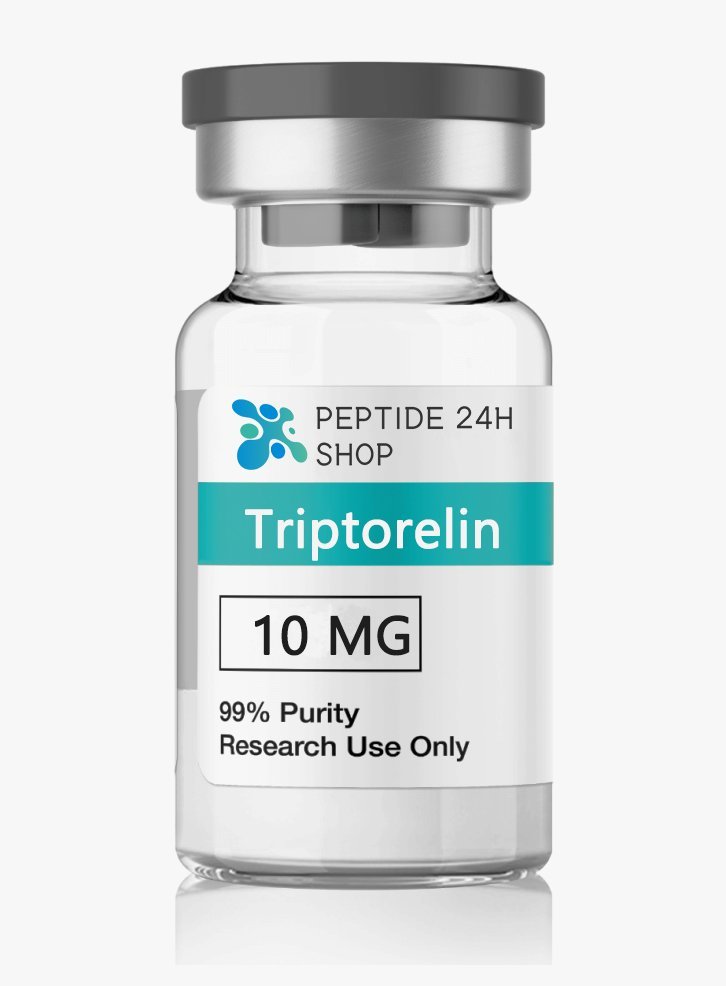
$50.00 – $395.00Price range: $50.00 through $395.00
CAS No.: 57773-63-4
Peptide Sequence: Pyr-His-Trp-Ser-Tyr-DTrp-Leu-Arg-Pro-Gly-NH2
Molecular Formula: C64H82N18O13
Molecular Weight: 1311.5
Appearance: White Lyophilized powder
Triptorelin peptide is a synthetic Gonadotropin-Releasing Hormone (GnRH) analogue used extensively in laboratory and preclinical research to study pituitary function, hormone regulation, and reproductive endocrinology. Its high stability, ≥98% purity, and reproducible activity make it a preferred tool for scientists studying GnRH receptor signaling, luteinizing hormone (LH) release, and follicle-stimulating hormone (FSH) pathways.
Researchers use Triptorelin to model complex endocrine processes accurately, both in vitro and in vivo, allowing for deeper understanding of hormonal feedback mechanisms and reproductive biology.
Triptorelin is a decapeptide analogue of natural GnRH that regulates the secretion of LH and FSH from the pituitary gland. By mimicking natural GnRH, it provides a controlled method for studying hormone release, endocrine signaling, and pituitary function in laboratory settings.
Triptorelin’s precise biological activity enables researchers to simulate natural GnRH effects and study hormonal regulation and receptor signaling with accuracy.
| Property | Description |
|---|---|
| Peptide Name | Triptorelin (GnRH analogue) |
| Amino Acid Length | 10 (decapeptide) |
| Purity | ≥98% (HPLC verified) |
| Form | Lyophilized powder |
| Molecular Weight | 1310.5 g/mol |
| Storage Temperature | –20°C (long-term stability) |
The high purity and stability of Triptorelin ensures consistent results in endocrine, reproductive, and pituitary research studies.
Triptorelin peptide is strictly intended for laboratory research. Its applications include:
Triptorelin is used to study pituitary hormone regulation, GnRH receptor activity, and feedback loops controlling LH and FSH secretion.
It enables researchers to investigate reproductive hormone pathways, ovulation triggers, and fertility-related mechanisms.
Triptorelin is valuable in analyzing GnRH-mediated intracellular signaling, receptor interactions, and downstream cellular responses.
Researchers use Triptorelin in in vitro and in vivo models to explore pituitary regulation, reproductive endocrinology, and hormonal feedback mechanisms.
Triptorelin peptide is for laboratory research use only.
It is not approved for human, veterinary, or clinical applications and must be handled by trained professionals in controlled laboratory environments.
Q1: What is Triptorelin peptide used for in research?
A: Triptorelin is primarily used for endocrine studies, pituitary hormone regulation, reproductive biology research, and GnRH signaling analysis.
Q2: What is the purity of Triptorelin?
A: High-quality Triptorelin peptide is ≥98% pure, verified using HPLC testing.
Q3: Can Triptorelin be used in humans or animals?
A: No, Triptorelin is strictly for laboratory research and not approved for clinical, human, or veterinary use.
Q4: How should Triptorelin peptide be stored?
A: Store lyophilized at –20°C. After reconstitution, refrigerate at 2–8°C and avoid repeated freeze-thaw cycles.
Q5: What research areas benefit from Triptorelin?
A: Triptorelin is widely applied in endocrinology, reproductive research, pituitary studies, and cellular signaling research.
Triptorelin peptide is a high-purity, research-grade GnRH decapeptide widely used for pituitary, endocrine, and reproductive studies. Its reproducible activity, chemical stability, and precise biological effects make it an essential tool for laboratories investigating hormonal regulation, receptor signaling, and reproductive endocrinology pathways.




&url=https://primehealthpharmacy.com/product/ghk-tripeptide-1/&media=https://primehealthpharmacy.com/wp-content/uploads/2026/01/GHK-Tripeptide-1.jpg)


&url=https://primehealthpharmacy.com/product/elamipretide-ss-31/&media=https://primehealthpharmacy.com/wp-content/uploads/2026/01/Elamipretide-SS-31.jpg)


