
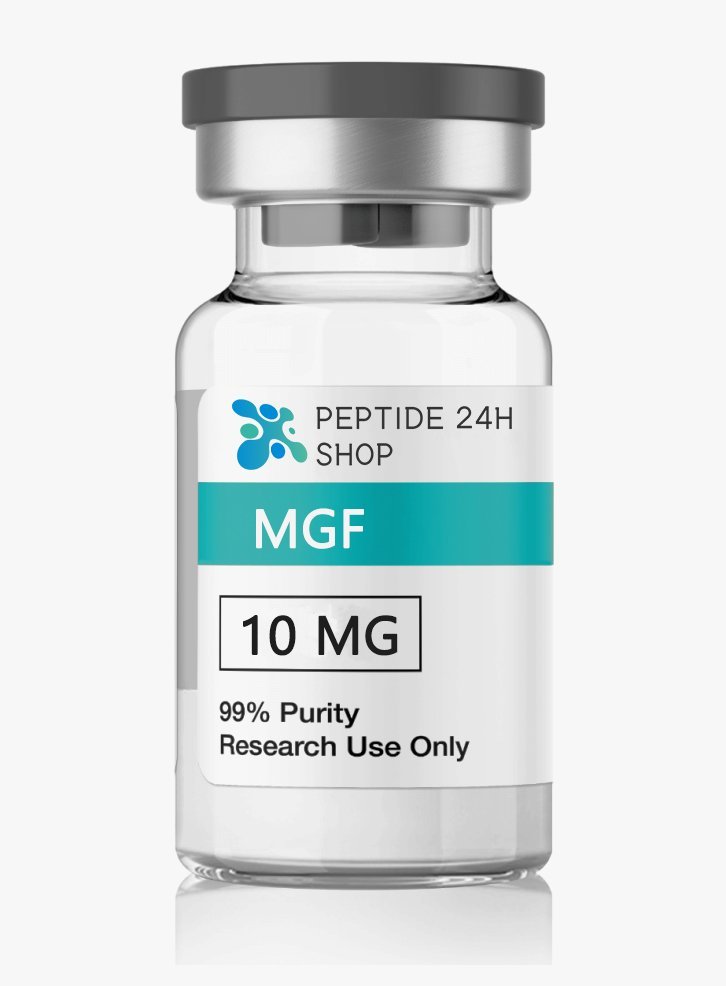
$95.00
Name: MGF; Mechano-Growth Factor
Peptide Sequence: Tyr-Gln-Pro-Pro-Ser-Thr-Asn-Lys-Asn-Thr-Lys-Ser-Gln-Arg-Arg-Lys-Gly-Ser-Thr-Phe-Glu-Glu-Arg-Lys
Molecular Formula: C121H199N40O40
Molecular Weight: 2868.19
Appearance: White Lyophilized powder
🧬 MGF Peptide – Mechano Growth Factor for Laboratory Research
Overview
Mechano Growth Factor (MGF) is a peptide fragment derived from the Insulin-like Growth Factor 1 (IGF-1) gene. It is widely studied for its role in muscle repair, regeneration, and growth in preclinical research models. MGF is commonly utilized in laboratory studies to investigate satellite cell activation, protein synthesis pathways, and cellular signaling associated with muscle adaptation.
Important: MGF peptide is intended for research use only and is not approved for human or veterinary applications.
Molecular Structure and Key Characteristics
MGF is a fragment of IGF-1 consisting of 7–24 amino acids, released in response to mechanical stress on muscle tissue. It plays a central role in activating satellite cells, which are essential for muscle repair and regeneration. Its defined structure and bioactivity make it a reliable model for studying tissue growth and recovery in vitro and in vivo.
Mechanism of Action
MGF promotes the proliferation of muscle satellite cells and enhances pathways involved in protein synthesis. Key areas of research include:
This makes MGF a valuable tool for exploring cellular growth and repair mechanisms in controlled experimental settings.
Research Applications
MGF peptide is used extensively in laboratory and preclinical research, including:
Its application is particularly relevant in studies of musculoskeletal disorders, injury recovery, and age-related muscle degeneration.
Quality and Purity
MGF peptide is synthesized under stringent laboratory conditions to ensure high bioactivity and experimental reliability:
High-quality standards ensure reproducibility and accuracy in laboratory studies.
Handling, Storage, and Safety
Proper handling is critical for maintaining peptide integrity:
Why MGF Peptide for Research?
MGF peptide serves as a robust tool for scientists exploring muscle physiology, cellular growth pathways, and regenerative biology.
Frequently Asked Questions (FAQ)













&url=https://primehealthpharmacy.com/product/ghk-tripeptide-1/&media=https://primehealthpharmacy.com/wp-content/uploads/2026/01/GHK-Tripeptide-1.jpg)


&url=https://primehealthpharmacy.com/product/elamipretide-ss-31/&media=https://primehealthpharmacy.com/wp-content/uploads/2026/01/Elamipretide-SS-31.jpg)


