
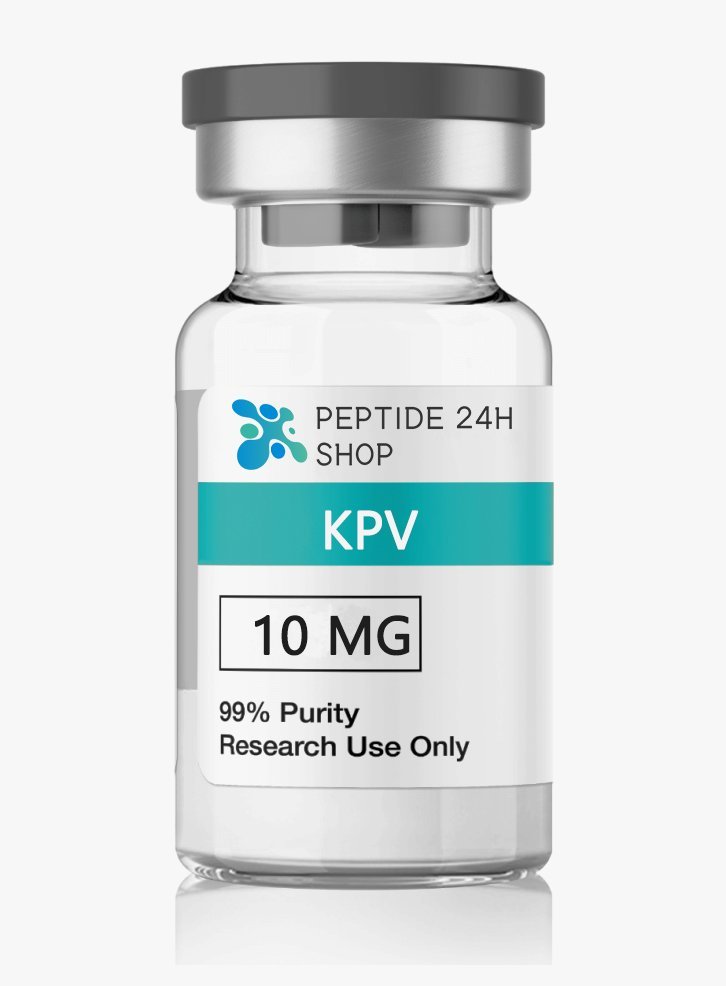
$50.00 – $199.00Price range: $50.00 through $199.00
Name: alpha-MSH(11-13); KPV; Lys-Pro-Val
CAS No.: 67727-97-3
Peptide Sequence: H-Lys-Pro-Val-OH
Molecular Formula: C16H30N4O4
Molecular Weight: 342.43
Appearance: White Lyophilized powder
KPV peptide is a naturally occurring tripeptide derived from the C-terminal sequence of alpha-melanocyte-stimulating hormone (α-MSH). It has attracted considerable interest in research due to its potential anti-inflammatory, antimicrobial, and tissue-repair properties.
Laboratory and preclinical studies have shown that KPV interacts with melanocortin receptors, which are involved in regulating inflammation, immune responses, and epithelial regeneration. Its small size, stability, and biological activity make KPV an important tool for studying inflammatory pathways, tissue repair, and immune signaling.
KPV peptide is intended solely for scientific research and is not approved for human or veterinary use.
KPV is a tripeptide composed of Lysine (K), Proline (P), and Valine (V). Despite its short sequence, it retains potent biological activity similar to full-length α-MSH while offering enhanced stability and minimal systemic effects.
Research has focused on KPV’s ability to:
Its minimal structure provides biochemical stability, cost-effectiveness, and versatility in cell biology, dermatology, and gastrointestinal research.
| Property | Specification |
|---|---|
| Chemical name | Lysine–Proline–Valine (KPV) |
| Molecular formula | C₁₆H₃₀N₄O₅ |
| Molecular weight | ~358.44 g/mol |
| Sequence | K–P–V |
| Purity (research grade) | ≥ 98% (HPLC verified) |
| Form | Lyophilized white/off-white powder |
| Solubility | Water or acetic acid |
| Storage | −20 °C, desiccated, light-protected |
| Stability | Up to 24 months (lyophilized) |
KPV peptide primarily acts through melanocortin receptors (MC1R and MC3R) on epithelial and immune cells. Receptor activation modulates inflammatory and immune signaling, including inhibition of NF-κB, a key mediator of inflammation.
In research models, KPV has demonstrated the ability to:
These properties make KPV a versatile tool for investigating inflammation, immune regulation, and tissue regeneration.
Although not approved for clinical use, KPV is widely studied for its biological effects across multiple systems:
a) Inflammatory Response Research
KPV is used to explore suppression of cytokine release and leukocyte infiltration.
b) Dermatology Studies
It supports wound healing, skin barrier restoration, and protection against oxidative stress.
c) Gastrointestinal Research
Investigated for epithelial regeneration, mucosal protection, and gut barrier integrity.
d) Antimicrobial Models
Shown to inhibit bacterial growth and maintain microbial balance in vitro.
e) Tissue Regeneration
Examined for effects on keratinocyte migration and fibroblast activity, key to tissue repair.
⚠️ Note: KPV peptide is strictly for laboratory research and is not a therapeutic agent.
| Feature | Research Benefit |
|---|---|
| Small, stable tripeptide | Easy synthesis and long-term stability |
| High bioactivity | Effective anti-inflammatory activity in vitro |
| Low cytotoxicity | Minimal cellular toxicity in research models |
| Multi-system relevance | Applicable to skin, gut, and immune studies |
| Cost-effective | Short sequence reduces production costs |
KPV’s combination of stability, activity, and versatility makes it a highly useful research peptide.
To maintain peptide integrity:
Ensure consistency and reliability in research by verifying:
Q1. What does KPV stand for?
Lysine–Proline–Valine, a tripeptide derived from α-MSH.
Q2. What is it used for in research?
Studying anti-inflammatory, antimicrobial, and regenerative processes.
Q3. Is KPV safe for humans?
No. It is intended solely for laboratory research.
Q4. How should it be stored?
Lyophilized at −20 °C in a dark, moisture-free environment.
Q5. Why is it important in inflammation research?
It inhibits key inflammatory signaling molecules, providing a model to study immune balance.
KPV peptide is a compact, potent, and versatile molecule for research in inflammation, tissue repair, and immune modulation. Derived from α-MSH, it offers stability, reproducibility, and multi-system applicability, making it a valuable tool in modern biomedical studies.
Disclaimer: This content is for educational and scientific purposes only. KPV peptide is not approved for medical or veterinary use and is intended exclusively for laboratory research.




&url=https://primehealthpharmacy.com/product/ghk-tripeptide-1/&media=https://primehealthpharmacy.com/wp-content/uploads/2026/01/GHK-Tripeptide-1.jpg)


&url=https://primehealthpharmacy.com/product/elamipretide-ss-31/&media=https://primehealthpharmacy.com/wp-content/uploads/2026/01/Elamipretide-SS-31.jpg)


