
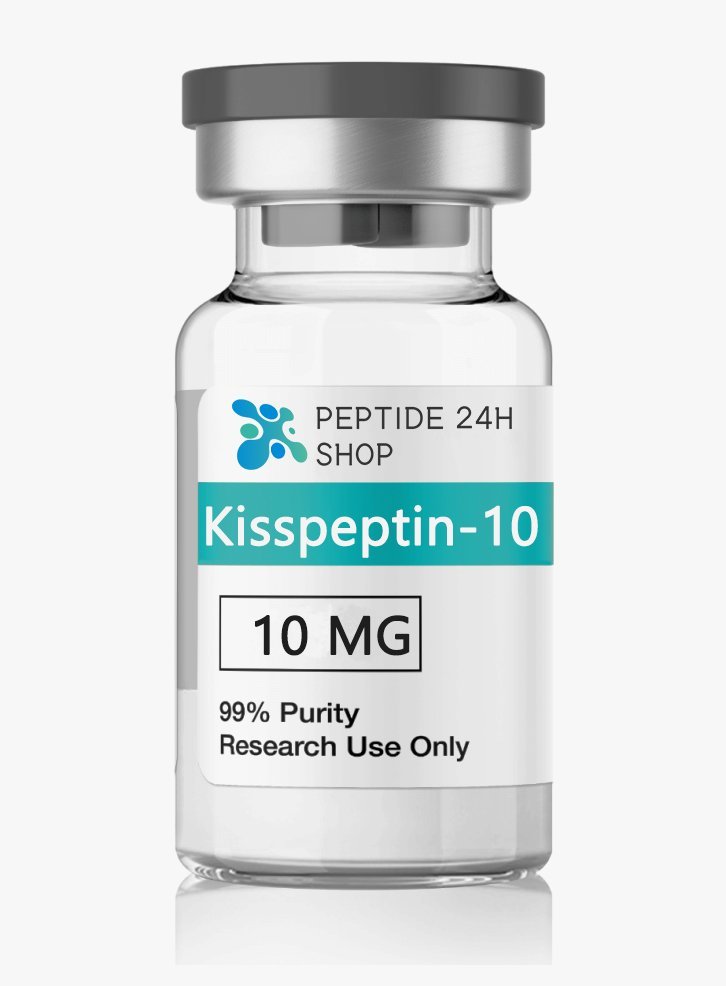
$50.00 – $399.00Price range: $50.00 through $399.00
Name: Kisspeptin-10; Kisspeptin 4-13; Kisspeptin-10 (4-13)
CAS No.: 374675-21-5
Peptide Sequence: Tyr-Asn-Trp-Asn-Ser-Phe-Gly-Leu-Arg-Phe-NH2
Molecular Formula: C63H83N17O14
Molecular Weight: 1302.4
Appearance: White Lyophilized powder
Kisspeptin-10 is a biologically active fragment of the Kisspeptin peptide family, which is centrally involved in the regulation of reproductive hormone signaling. Initially identified for its role in suppressing tumor metastasis, Kisspeptin-10 has since become a key subject of study in endocrinology, reproductive biology, and neuroendocrine research.
In experimental settings, Kisspeptin-10 is widely used to investigate the function of the hypothalamic–pituitary–gonadal (HPG) axis, particularly its control over gonadotropin-releasing hormone (GnRH) secretion. Through this pathway, it influences processes related to puberty, fertility, and hormonal balance.
Kisspeptin-10 is intended exclusively for laboratory research and is not approved for human or veterinary use.
Kisspeptin-10 is a short peptide composed of 10 amino acids and represents an active fragment of the longer Kisspeptin-54 (metastin) sequence. Despite its reduced length, it retains full biological activity and demonstrates strong binding affinity for the GPR54 receptor, also known as the Kiss1 receptor.
Activation of this receptor stimulates the release of GnRH from hypothalamic neurons, which subsequently promotes secretion of luteinizing hormone (LH) and follicle-stimulating hormone (FSH) from the pituitary gland.
These hormones are essential for regulating reproductive function, gamete development, and the onset of puberty, making Kisspeptin-10 a critical tool in fertility and hormone regulation research.
| Property | Specification |
|---|---|
| Chemical name | Kisspeptin-10 (Human) |
| Amino acid sequence | Tyr-Asn-Trp-Asn-Ser-Phe-Gly-Leu-Arg-Phe-NH₂ |
| Molecular formula | C₆₄H₈₄N₁₆O₁₃ |
| Molecular weight | ~1,302.5 g/mol |
| Form | Lyophilized powder |
| Purity (research grade) | ≥ 98% (HPLC verified) |
| Solubility | Water or dilute acetic acid |
| Storage conditions | −20 °C, protected from light and moisture |
| Stability | Up to 24 months (lyophilized) |
Kisspeptin-10 exerts its biological effects through activation of the GPR54 receptor located on GnRH-producing neurons in the hypothalamus. This interaction initiates a tightly regulated hormonal signaling cascade.
Key steps in this mechanism include:
This well-defined pathway makes Kisspeptin-10 a valuable research compound for studying endocrine feedback systems, fertility regulation, and pubertal development.
Although Kisspeptin-10 is not approved for therapeutic use, it is widely studied in preclinical and experimental models.
a) Reproductive Biology Research
Kisspeptin-10 is used to examine the initiation of puberty and the regulation of fertility through hormonal signaling pathways.
b) Endocrine System Studies
It serves as a precise tool for analyzing hypothalamic–pituitary communication and hormonal feedback mechanisms.
c) Hormonal Dysregulation Models
Researchers employ Kisspeptin-10 to investigate conditions associated with delayed puberty, infertility, or suppressed gonadotropin release.
d) Neuroendocrine Research
Its role in linking reproductive control with central nervous system signaling has made it a focus of neuroendocrine studies.
e) Comparative and Evolutionary Biology
Due to its conserved function across mammalian species, Kisspeptin-10 is useful for comparative studies of reproductive regulation.
⚠️ Note: All findings are derived from laboratory research. Kisspeptin-10 is not an approved drug, supplement, or therapeutic agent.
| Feature | Research Benefit |
|---|---|
| High receptor affinity | Consistent activation of GPR54 |
| Compact peptide structure | Efficient synthesis and handling |
| Reproducible hormonal response | Reliable GnRH stimulation |
| Cross-species activity | Applicable in multiple research models |
| Favorable in vitro profile | Well suited for cellular studies |
To preserve peptide quality and performance:
When sourcing Kisspeptin-10, laboratories typically confirm:
These criteria help ensure consistency, reliability, and reproducibility in experimental work.
Q1. What is Kisspeptin-10 studied for?
Its role in stimulating GnRH release and regulating reproductive hormone signaling.
Q2. How does Kisspeptin-10 differ from Kisspeptin-54?
It is a shorter, biologically active fragment with similar functional activity and improved stability for research use.
Q3. Is Kisspeptin-10 approved for medical use?
No. It is intended strictly for laboratory research purposes.
Q4. Why is it important in fertility research?
It initiates the hormonal cascade required for ovulation and spermatogenesis.
Q5. What research fields commonly use Kisspeptin-10?
Endocrinology, reproductive biology, neuroendocrinology, and developmental biology.
Kisspeptin-10 is a critical research peptide for understanding the hormonal mechanisms that govern reproduction, puberty, and fertility. By acting as a potent activator of the GnRH–LH–FSH axis, it provides valuable insight into endocrine regulation.
Its stability, potency, and reproducibility make Kisspeptin-10 an essential tool in modern reproductive and hormonal research.
Disclaimer: This content is provided for scientific and educational purposes only. Kisspeptin-10 peptide is not approved for medical or veterinary use and is intended exclusively for laboratory research.





&url=https://primehealthpharmacy.com/product/ghk-tripeptide-1/&media=https://primehealthpharmacy.com/wp-content/uploads/2026/01/GHK-Tripeptide-1.jpg)


&url=https://primehealthpharmacy.com/product/elamipretide-ss-31/&media=https://primehealthpharmacy.com/wp-content/uploads/2026/01/Elamipretide-SS-31.jpg)


