
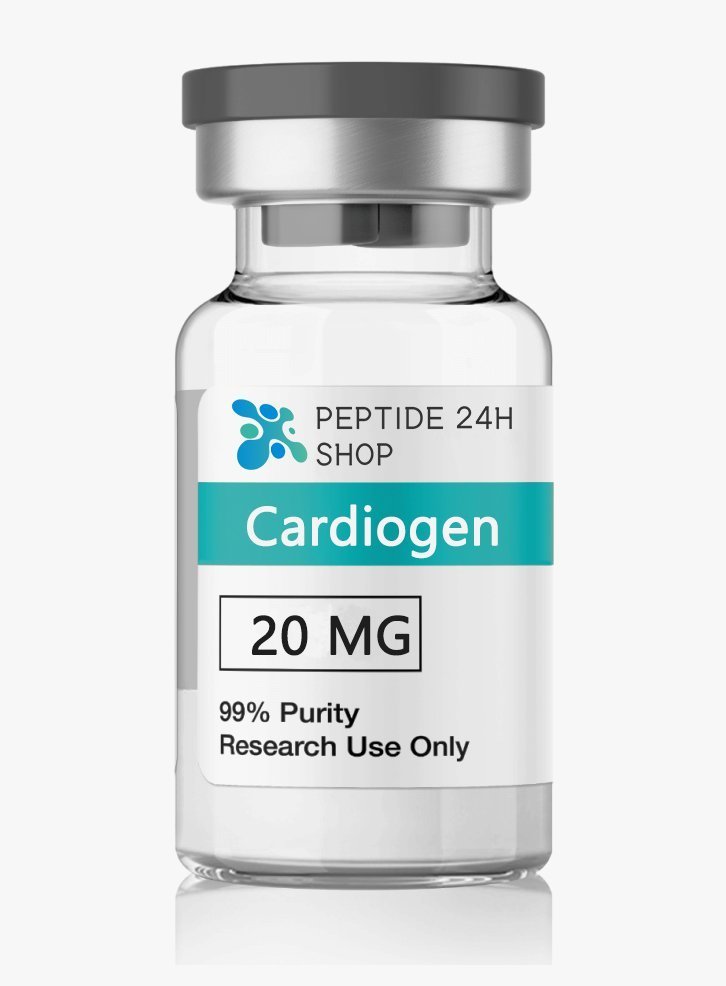
$50.00 – $165.00Price range: $50.00 through $165.00
CAS No.: N/A
Peptide Sequence: H-Ala-Glu-Asp-Arg-OH
Molecular Formula: C18H31N7O9
Molecular Weight: 489.5
Appearance: White Lyophilized powder
In the expanding field of peptide bioregulators, Cardiogen peptide (AEDR) has gained attention in cardiovascular-focused laboratory research. Classified as a short synthetic tetrapeptide, Cardiogen is being investigated for its potential role in cardiac tissue regulation, cardiomyocyte resilience, fibroblast modulation, and heart cell repair pathways in experimental models.
Although sometimes described as a “heart-specific bioregulatory peptide,” Cardiogen is not approved for therapeutic use in humans. Its applications remain confined to laboratory, in vitro, and preclinical research settings.
This guide provides an evidence-based overview of:
All information below is provided for educational and research awareness purposes only.
Cardiogen is a synthetic tetrapeptide with the amino acid sequence:
H-Ala-Glu-Asp-Arg (AEDR)
It is commonly categorized as a bioregulatory or organ-specific peptide, with research focusing primarily on cardiac and heart tissue models.
Cardiogen is marketed by research suppliers strictly for laboratory purposes and is not approved by regulatory agencies for therapeutic application.
While validated human clinical data are lacking, in vitro and animal studies provide insight into how Cardiogen may function at the cellular level.
Experimental models suggest Cardiogen may:
These findings have positioned Cardiogen within research exploring cardiac cell regeneration and resilience.
Cardiac fibroblasts play a central role in extracellular matrix production and scar formation after heart injury.
Preclinical data suggest Cardiogen may:
Because excessive fibrosis contributes to cardiac remodeling, this mechanism remains an area of ongoing investigation.
Some experimental findings and supplier literature associate Cardiogen with:
Although preliminary, these findings link Cardiogen to broader research into mitochondrial function in heart tissue.
Certain laboratory studies suggest Cardiogen may influence expression of:
This potential regulation of cytoskeletal and nuclear architecture may contribute to improved cellular stability in aging or stressed heart tissue models.
Important: These mechanisms are derived from experimental systems and do not establish therapeutic benefit in humans.
Current evidence is largely limited to laboratory and animal research:
These studies provide mechanistic insights but do not confirm clinical efficacy.
At present:
Any use outside controlled research environments is not supported by established clinical evidence.
For peptide information sites, research catalogs, or educational platforms, the following non-medical considerations are typically included.
Cardiogen peptide is generally supplied as a lyophilized (freeze-dried) powder.
Standard laboratory practices include:
Because Cardiogen is not approved for human use, dosing information applies only to research settings.
Human-equivalent dosing is not established.
Because Cardiogen remains investigational:
Content discussing Cardiogen should avoid therapeutic claims and emphasize its experimental status.
Although not approved for medical treatment, Cardiogen is being explored in several experimental research areas:
These remain investigational domains and do not imply clinical efficacy.
If publishing content or product listings referencing Cardiogen:
Cardiogen peptide (AEDR) is a short synthetic tetrapeptide investigated for its potential influence on cardiac cell regulation, fibroblast modulation, mitochondrial efficiency, and structural protein expression in preclinical models.
While early laboratory data are intriguing, evidence remains limited to experimental systems. Cardiogen is not approved for therapeutic use and should be understood strictly as an investigational research peptide.
For educational and research audiences, the most accurate framing emphasizes:
Disclaimer: This content is for informational and educational purposes only. Cardiogen peptide is not approved for therapeutic or dietary use in humans. All discussion refers to research and experimental contexts only.




&url=https://primehealthpharmacy.com/product/ghk-tripeptide-1/&media=https://primehealthpharmacy.com/wp-content/uploads/2026/01/GHK-Tripeptide-1.jpg)


&url=https://primehealthpharmacy.com/product/elamipretide-ss-31/&media=https://primehealthpharmacy.com/wp-content/uploads/2026/01/Elamipretide-SS-31.jpg)


