
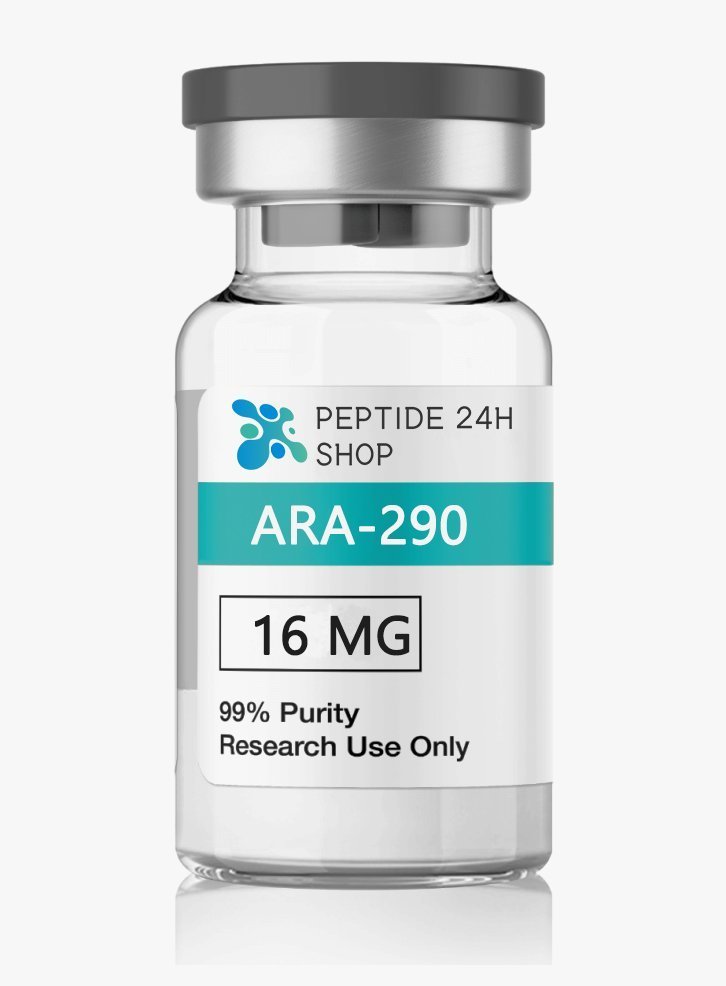
$180.00 – $490.00Price range: $180.00 through $490.00
Name: ARA-290; ARA290; ARA 290; Cibinetide
CAS No.: 1208243-50-8
Peptide Sequence: Pyr-Glu-Gln-Leu-Glu-Arg-Ala-Leu-Asn-Ser-Ser
Molecular Formula: C51H84N16O21
Molecular Weight: 1257.31
Appearance: White Lyophilized powder
ARA‑290 (also called cibinetide or the Helix B Surface Peptide, HBSP) is a synthetic 11-amino-acid peptide derived from a non-erythropoietic portion of erythropoietin (EPO). Unlike full EPO, which stimulates red blood cell production, ARA‑290 is designed to selectively activate the innate repair receptor (IRR). This receptor triggers tissue-protective and anti-inflammatory pathways without causing erythropoiesis.
ARA‑290 has gained attention in experimental and early clinical settings for potential roles in nerve repair, neuroprotection, metabolic modulation, and immune regulation. However, it remains an investigational peptide and is not approved for general medical use.
This article summarizes the science behind ARA‑290, highlights research findings, and covers practical considerations including storage, dosing, safety, and research limitations.
ARA‑290 binds to the IRR, a receptor complex formed by the EPO receptor and the β-common receptor subunit (CD131). Activation of the IRR is thought to:
Importantly, it does this without stimulating red blood cell production, separating the tissue-protective effects of EPO from its hematopoietic effects.
Laboratory studies show that ARA‑290 can:
In animal models of nerve injury and neuropathic pain, ARA‑290 has demonstrated reduced sensitivity to harmful stimuli (mechanical and cold allodynia) over extended periods, suggesting it may modulate the neuroimmune response rather than simply act as a pain reliever.
In small clinical trials of people with type 2 diabetes and neuropathy, ARA‑290 was associated with:
These effects may stem from lower oxidative stress, reduced inflammation, and improved microvascular integrity.
Animal studies indicate that ARA‑290:
These findings highlight ARA‑290’s potential for neuroprotection, immune modulation, and tissue repair.
While promising, these studies are early-stage, small-scale, and short-term, highlighting the need for larger trials.
ARA‑290 is a promising investigational peptide designed to separate the protective effects of EPO from red blood cell stimulation. While preclinical and early human studies are encouraging, it is important to note:
All information provided is for educational purposes only and does not constitute medical advice. Anyone considering ARA‑290 should consult qualified medical or research professionals.






&url=https://primehealthpharmacy.com/product/ghk-tripeptide-1/&media=https://primehealthpharmacy.com/wp-content/uploads/2026/01/GHK-Tripeptide-1.jpg)


